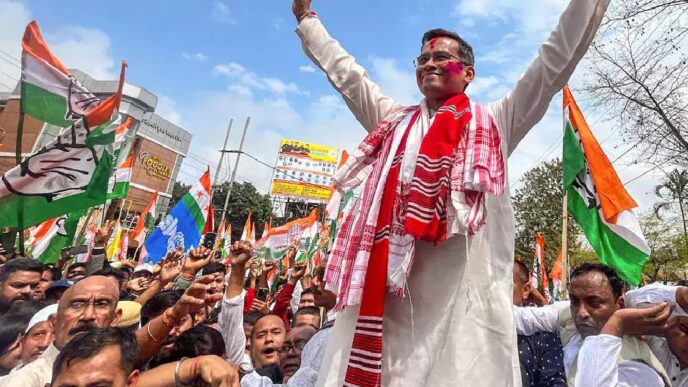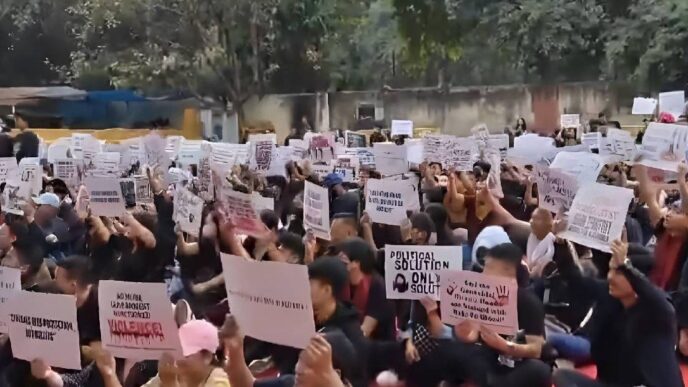




The mystery surrounding the death of Assam’s cultural icon Zubeen Garg has now crossed the boundary of tragedy and entered the territory of a political scandal; one that appears tightly wound around the Ministry of External Affairs (MEA) under Union Minister of State Pabitra Margherita. What began as a set of straightforward questions about safety lapses and delegation protocols has, in the course of two months, morphed into a labyrinth of secrecy, contradictions and bureaucratic stonewalling. At the center of this growing firestorm stands Margherita; Zubeen’s close friend, travelling companion, political ally and the minister whose team has refused to release even the most basic documents related to the event where the singer died.
For weeks, Guwahati’s CrossCurrent has been tracking the timeline, the paperwork and the testimonies surrounding Zubeen’s final days in Singapore as well as the opaque funding of the North East India Festival held in the same city. Each new strand leads back to one uncomfortable truth: everything the public needs to know about the festival’s finances, the delegation movements, the approvals and the safety arrangements lies locked behind the doors of the MEA. And every attempt to open those doors has met the same response: silence.
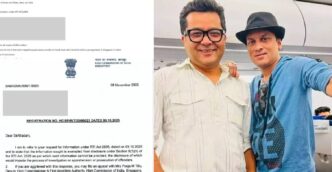
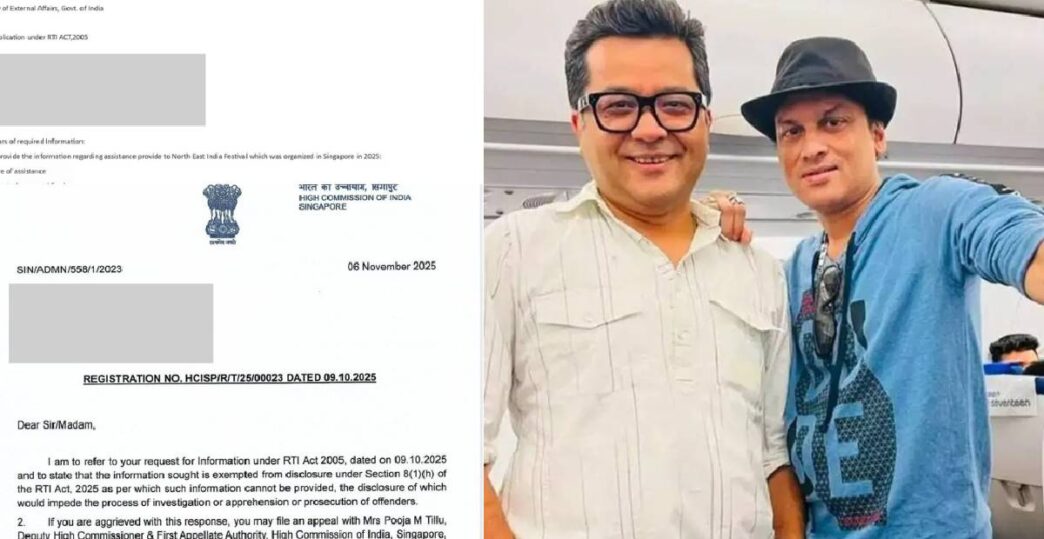
The turning point came on November 6, 2025, when the High Commission of India in Singapore formally rejected an RTI request seeking details of the Singapore festival’s funding and approvals. The request was simple: What assistance did the MEA provide to the festival? How much money was sanctioned? What documents were submitted by the organisers? Where is the approval letter? These are routine government records, typically in the public domain. Yet the reply invoked Section 8(1)(h) of the RTI Act—an exemption reserved for ongoing criminal investigations. The bureaucratic language was clear, but the implication was stunning: the High Commission claimed that releasing information about a cultural event could “impede the process of investigation or prosecution of offenders.” 
This is not standard practice. It is an extraordinary shield. And the question that the MEA must answer but refuses to is: What criminal investigation is underway that is so sensitive it requires burying the festival’s paperwork? Or is the clause being used as a smokescreen to keep politically inconvenient information out of public reach?
The timing makes the concealment even more suspect because Zubeen Garg died during the very event whose files are now being blocked. When a death especially a suspicious one occurs in connection with a government-backed programme, transparency is not optional; it is mandatory. Yet transparency is precisely what has been denied since the first day of the controversy.
The government’s behaviour since then has only deepened public suspicion. Chief Minister Himanta Biswa Sarma initially declared Zubeen’s death a “murder,” a statement he later softened without explaining why. He then added that investigators had uncovered “shocking details” but refused to elaborate. These dramatic swings, coming from the state’s highest authority, raised expectations of a rigorous investigation. But that expectation evaporated when evidence began emerging that the Special Investigation Team (SIT) was not following basic protocols. Raijor Dal MLA Akhil Gogoi revealed that the SIT did not even visit the site in Singapore where Zubeen died an omission that would be unthinkable in any serious inquiry. If a death occurs in a foreign location, visiting the scene is the first step. Yet in this case, it was skipped altogether.
Gogoi went further, naming individuals he believes are being protected: Pabitra Margherita, Riniki Bhuyan Sarma, Shyamkanu Mahanta and Jayanta Sharma. If his allegations are correct, then the SIT is avoiding questioning the very people with the most influence, the most proximity, or the most to lose. Gogoi called it “theatrics,” referring to the SIT’s public promises to file a chargesheet by December 8 as nothing more than a diversion meant to give the appearance of progress while the core questions remain untouched.
Even, Congress CLP leader Debabrata Saikia has written to both the President of India and the Chief Justice of the Gauhati High Court, highlighting a series of procedural lapses severe enough to justify a judicially monitored CBI–CID inquiry. Saikia pointed out that the CM himself had publicly acknowledged Zubeen’s health vulnerabilities before the Singapore trip. If that is true, then why did neither the Assam government nor the MEA provide medical oversight? Why was Zubeen permitted to engage in high-risk activities near the water without life jackets, supervision, or logistical support? And why did the MEA delegation led by none other than his friend-turned-minister Pabitra Margherita fail to communicate his health concerns to Singapore authorities?
These are not political questions. They are questions rooted in duty of care. When an artist travels as part of a government-sponsored delegation, the ministry assumes responsibility. That responsibility appears to have been neglected or worse, ignored.
To add to the mystery, External Affairs Minister S. Jaishankar never contacted Zubeen’s family after the death. This is unprecedented. For a high-profile figure to die during an MEA-linked event, without the ministry engaging directly with the family, is not a protocol lapse. It is a deliberate refusal to acknowledge accountability.
Then comes the festival itself. For years, the North East India Festival has been handled by event manager Shyamkanu Mahanta. Critics have long accused the programme of being controlled by a tight-knit circle of politically connected interests who determine which artists are invited, how funds are distributed, and who benefits from the government support. In this context, withholding the funding records is not just suspicious—it is explosive. If the Singapore festival’s money trail reveals irregularities, political patronage, or crony networks, it could directly implicate MEA officials or event organisers. It could also expose why certain individuals were present in Singapore and why certain decisions were made in the days leading up to Zubeen’s death.
CrossCurrent’s investigation indicates that delegation itineraries, communications, and approvals could reveal whether safety warnings were ignored, whether specific individuals pressured organisers for certain privileges, or whether the festival was used to funnel funds to private entities. These documents would also show who was responsible for handling Zubeen’s schedule, travel, and leisure activities. But every request for these documents has been stonewalled. And the only office that has the power to declassify them belongs to Pabitra Margherita.
This is the central paradox: the man who claims to want the truth to come out is the same man whose ministry is blocking the flow of information. If Margherita has nothing to hide, why is the MEA denying basic administrative files? Why is the ministry acting as if the festival’s documents are a national security threat? Why is a cultural programme now treated as if it is part of a criminal conspiracy investigation?
Unless the government releases the festival’s funding records, delegation logs, communication trails, and approval documents, the public will continue to see a cover-up—one that shields individuals who were closest to Zubeen during his final hours.
The questions are no longer just about negligence. They are about potential culpability.
What happened in Singapore was not just an accident lost in confusion.. It is a story of systematic concealment, a story that the MEA, under Pabitra Margherita is working very hard to keep buried under bureaucratic clauses, incomplete statements, and selective outrage.
The longer the government refuses to release the documents, the stronger the suspicion becomes:
Someone is being protected. Someone is being shielded. And someone is terrified of what the paperwork will reveal.