




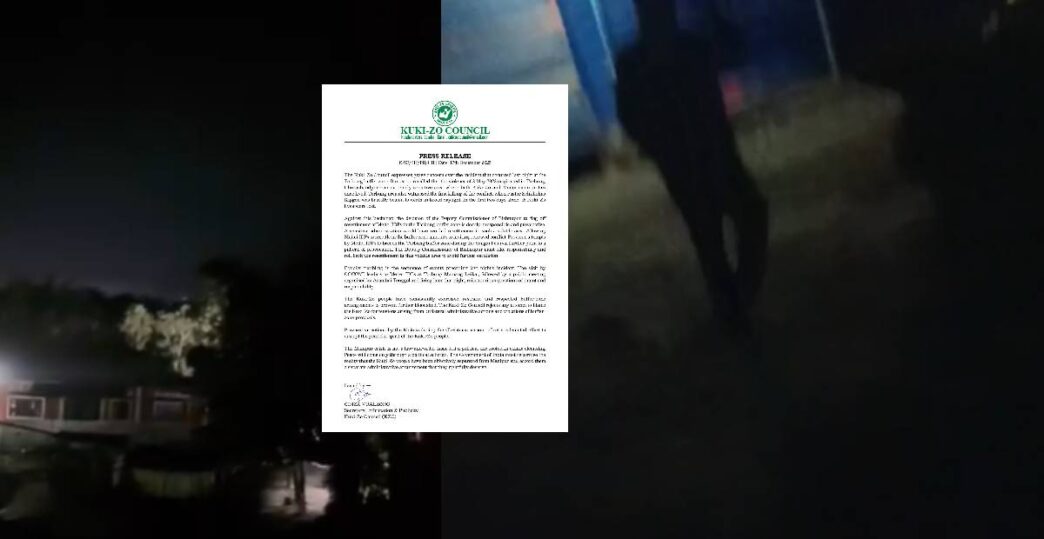
The Kuki-Zo Council (KZC) today expressed concern over an incident reported from the Torbung buffer zone in Manipur, warning that recent administrative decisions could further worsen an already fragile situation in the conflict-affected area.
In a press release issued on December 17, the Kuki-Zo Council recalled that Torbung, located in Churachandpur district, was one of the first flashpoints of the ethnic violence that erupted on May 3, 2023. The council said the area is highly sensitive, as both Kuki-Zo and Meitei communities once lived there before the conflict forced large-scale displacement.
The KZC pointed out that Torbung had witnessed some of the earliest and most violent incidents during the initial days of unrest. According to the council, the first killing of the conflict took place in Torbung, where Pastor Sekhikhohao Kipgen was allegedly beaten to death in public. The council further stated that in the first two days of violence, at least 45 Kuki-Zo people lost their lives. 
Against this background, the council criticised the decision of the Bishnupur Deputy Commissioner to flag off the resettlement of Meitei internally displaced persons (IDPs) in the Torbung buffer zone. The KZC described the move as “deeply irresponsible” and said it had the potential to provoke fresh tensions in an area that remains volatile.
The council argued that a more cautious approach was required in such a sensitive region. It stated that allowing resettlement in the buffer zone could invite renewed confrontation and undo efforts made to prevent further bloodshed. The KZC also referred to earlier attempts by Meitei IDPs to enter the Torbung buffer zone during the Sangai Festival, claiming these incidents reflected a pattern of provocation.
Calling for accountability, the Kuki-Zo Council urged the Bishnupur district administration to take responsibility for the situation and roll back the resettlement process in Torbung. According to the council, such a step is necessary to avoid further escalation and to maintain the fragile calm that exists in parts of the state.
The press release also raised concerns about events leading up to the latest incident. The council referred to a visit by leaders of the Coordination Committee on Manipur Integrity (COCOMI) to Meitei IDPs at Torbung Mamang Leikai. This visit, followed by a public meeting organised by Arambai Tenggol and a reported firing incident later the same night, was described by the KZC as troubling.
According to the council, the sequence of these events raises serious questions about intent and responsibility. The KZC said such actions only deepen mistrust and fear among communities already traumatised by months of violence.
Reiterating its position, the Kuki-Zo Council stated that the Kuki-Zo people have consistently exercised restraint throughout the conflict. It said the community has respected buffer-zone arrangements put in place to prevent further violence and loss of life. The council strongly rejected any attempt to blame the Kuki-Zo people for tensions arising from what it described as unilateral administrative actions and violations of buffer-zone protocols.
The KZC also alleged that certain actions carried out during the Christmas season were provocative in nature. It claimed these moves appeared to be aimed at disturbing the peaceful observance of the festival by the Kuki-Zo community, adding that such actions only add to the sense of insecurity.
Taking a broader view of the crisis, the Kuki-Zo Council reiterated its long-standing position that the Manipur conflict is not merely a law-and-order problem. According to the council, the roots of the crisis are political and linked to deep ethnic divisions. It said lasting peace can only be achieved through a political solution rather than temporary administrative measures.
In its statement, the council appealed to the Government of India to recognise what it described as the ground reality in Manipur. It claimed that the Kuki-Zo people have effectively been separated from the rest of the state due to the prolonged violence and breakdown of trust. The KZC once again demanded a separate administrative arrangement for the Kuki-Zo people, stating that this was the only way to ensure security, dignity, and lasting peace.