



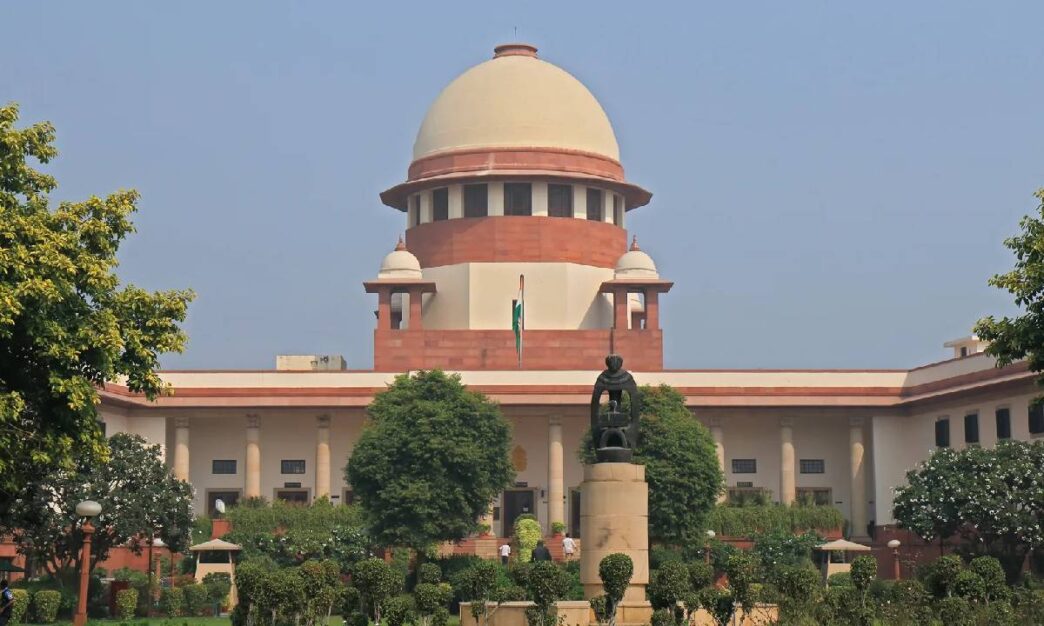
The Supreme Court has asked the Election Commission of India to explain why it has decided to carry out only a special revision of Assam’s electoral rolls before the 2026 Assembly elections instead of conducting a special intensive revision, which is generally seen as a more detailed process. The matter came up before a bench of Chief Justice Surya Kant and Justice Joymalya Bagchi on Tuesday, and the court has fixed December 16 for the next hearing in the case.
The petition has been filed by former Gauhati High Court Bar Association president Mrinal Kumar Choudhury. His counsel, senior advocate Vijay Hansaria, argued that Assam has been treated differently even though the state has a long history of concerns related to illegal immigration. He informed the court that in several other states a detailed intensive revision is underway in which voters must submit documents, but voters in Assam are not being asked to produce any such documents. He said this raises questions, especially after recent court rulings relating to citizenship matters.
The bench, however, pointed out that Assam has certain special laws in place, and it also has Foreigner Tribunals which may have influenced the Election Commission’s approach. The Chief Justice observed that the Commission might have chosen a different method only for Assam because of these factors. The court made it clear that it will first hear the Commission before considering any request to stop the ongoing process. 
The petition refers to previous reports and official comments about the scale of migration into Assam over past decades. It says that this background should require a more careful verification process rather than a simpler one. It also notes that states such as Bihar, Rajasthan, Tamil Nadu, Uttar Pradesh and several others are carrying out a more intensive revision process.
Meanwhile, the state government has welcomed the special revision exercise. Assam Chief Minister Himanta Biswa Sarma recently said that using January 1, 2026 as the qualifying date would help the state prepare accurate electoral rolls. He said the state administration would fully support the work of the Election Commission.
The Commission has clarified that its decision was made after discussions and after examining issues related to the National Register of Citizens and the category of doubtful voters, whose status is decided separately by tribunals or courts. According to the Commission, these voters will continue to appear in the draft rolls unless a tribunal or court gives a fresh order.
The Election Commission has also explained that the two types of revision follow different procedures. In a special intensive revision, voters are expected to submit documents along with printed forms, but the special revision process uses pre-filled registers and regular forms that do not require documents to be attached. The court is now waiting for the Commission’s reply before taking a further view on the matter.