



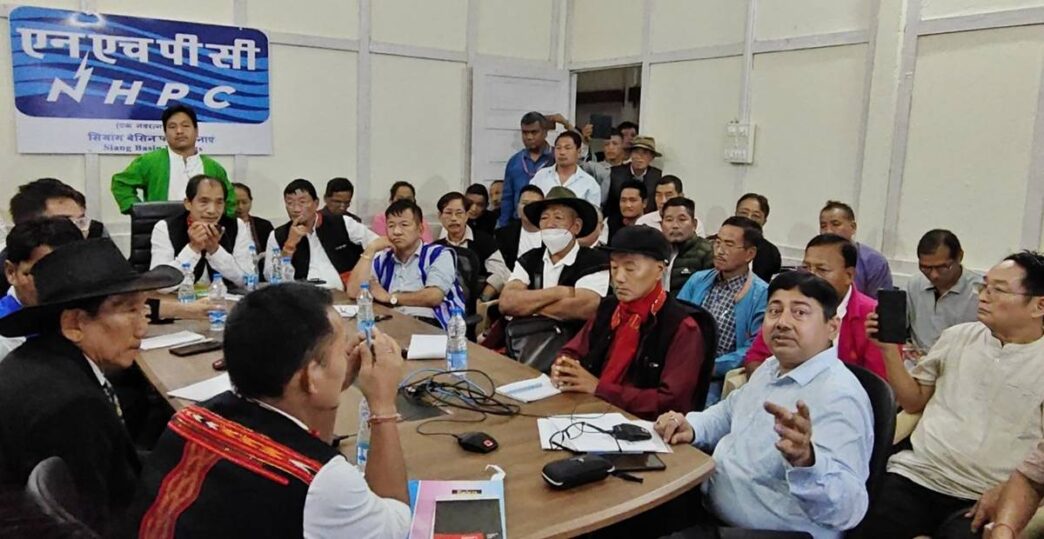
The National Hydroelectric Power Corporation (NHPC) Ltd held a detailed consultative discussion with local community groups on the Siang Upper Multipurpose Project (SUMP) on October 4 at its Pasighat office in East Siang district.
Delegations from the Adi Baane Kebang (ABK) and the Siang Indigenous Farmers’ Forum (SIFF) attended the meeting. ABK President Shri Tanon Tatak, along with other ABK executive members, and SIFF President Shri Amok Padung and Secretary Shri Likeng Libang, participated in the discussions. Members from Siang and Upper Siang districts were also present. State Nodal Officer for SUMP Shri Atek Miyu and Assistant Commissioner Riga Shri Philip Jerang joined the meeting as well.
Shri Amar Nath Jha, General Manager (Civil) and Head of Project for NHPC’s Siang Lower Project, presented an overview of the SUMP. He highlighted that the project, declared a National Project by the Government of India, is designed to provide flood moderation, water security, and clean hydropower. He also noted that it will bring regional growth through better infrastructure, local employment, and community welfare programs. 
“The Siang Upper Multipurpose Project is not just about generating power. It is about securing the future of the Siang valley,” Shri Jha told the gathering. “We aim to work together with local communities to develop the project in a way that promotes growth while protecting Arunachal Pradesh’s unique culture and environment.”
During the meeting, ABK President Shri Tanon Tatak and other members raised questions to clarify their doubts. Shri Jha responded with detailed explanations on the project’s benefits and processes. Shri Tatak suggested that future consultative meetings be held with Project Affected Families (PAFs), followed by discussions with the State Government and NHPC.
The NHPC also appealed to the ABK to support the Pre-Feasibility Report (PFR) and help create awareness about the importance of the SUMP at the grassroots level. It was assured that preparation of the Detailed Project Report (DPR), including the Environmental Impact Assessment (EIA), Environmental Management Plan (EMP), Social Impact Assessment (SIA), and plans for land acquisition, resettlement, and rehabilitation, will involve consultations with stakeholders at every stage.