



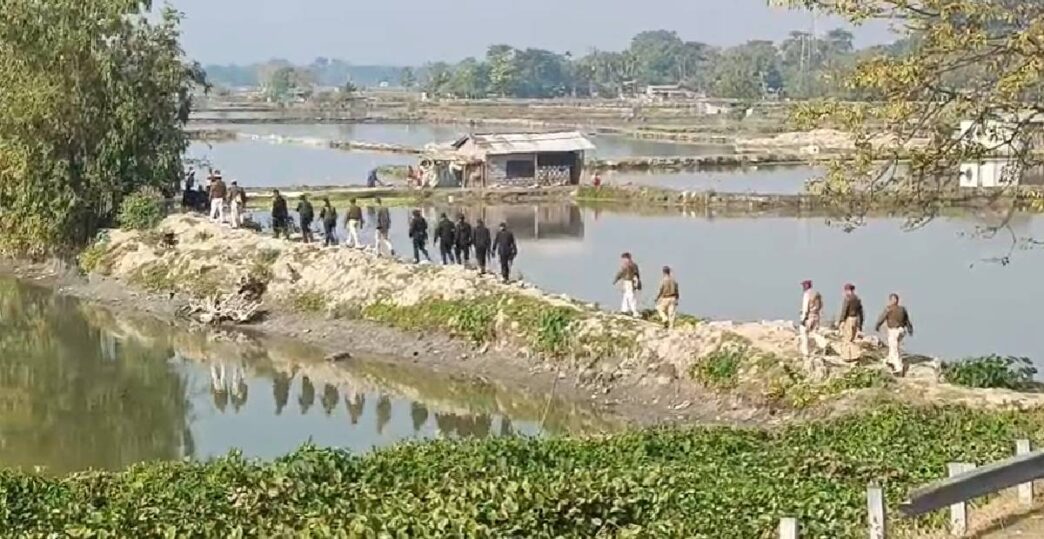
The Nagaon district administration is currently conducting an eviction operation in the Dhing Revenue Circle, targeting encroached sections of natural wetlands known as beels. The ongoing drive aims to clear approximately 230 bighas of land, including around 500 fisheries that officials have identified as illegal conversions of public water bodies into private ponds.
Saurabh Kumar Das, Circle Officer of Dhing, explained the objectives of the drive and said, “We will clear 230 bighas of land. There are around 500 illegal fisheries. Once these are demolished, water that has remained stagnant and unable to flow for the past eight years will resume its natural movement, addressing a major problem faced by local residents.” He added that detailed surveys, including drone mapping, were carried out to accurately identify encroachments and support restoration efforts. He further indicated that similar operations are expected to continue in the future to sustain these measures.
The drive is encompassing various sites, including Chalanabari, Bherbheri, Tuktuki, Ahom Gaon, Katah Guri, and zones around Rowmari Beel, Moiradhaj, and Magurmari. Substantial police forces have been deployed to maintain peace and order during the process. 
This initiative builds on prior actions in the region, such as the significant operation on November 29 in the Lutumari Reserved Forest under Kampur Revenue Circle, which reclaimed nearly 5,962 bighas of forest land. Additional recent drives have targeted riverbanks and other protected areas.
Administrative and Environmental Viewpoint: Officials contend that the fisheries represent unauthorized encroachments on government wetlands. Beels are vital to Assam’s ecology, serving as natural flood absorbers, habitats for biodiversity, and recharge zones for groundwater. Unauthorized transformations into ponds have allegedly caused water stagnation, disrupted flows, and heightened flood vulnerabilities for surrounding areas.
Restoring these wetlands by removing structures and excavating ponds is intended to revive free water movement after prolonged blockage. Where encroachments are confirmed as illegal, these steps promote ecological restoration, flood prevention, and fair access to communal resources.
The administration reports that advance notices were distributed, and surveys encouraged voluntary adherence, mirroring cases elsewhere in the district where self-removal prevented escalation. Authorities assert compliance with legal requirements for protecting public lands.