



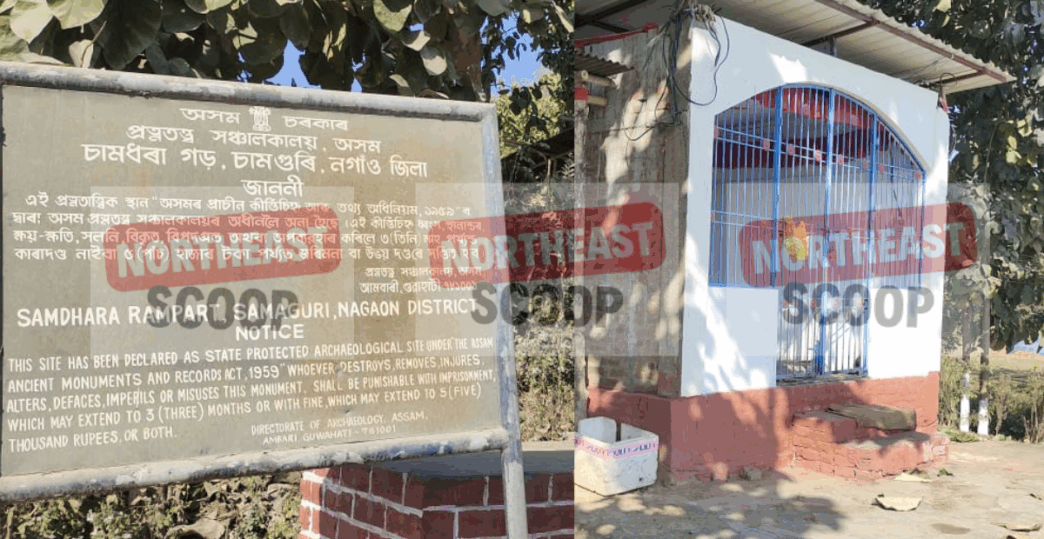
Serious questions have been raised over the Assam government’s commitment to protecting Ahom-era heritage sites after a permanent Kali Mandir structure came up inside the protected Samdhara Fort area in Nagaon district, allegedly with official approval.
Speaking exclusively to Northeast Scoop, Ahom Sabha State General Secretary Tapan Kumar Gogoi strongly condemned the development, calling it a “clear and unacceptable violation” of heritage protection laws. He said the construction of the Kali Mandir at the historic site shows complete disregard for Assam’s history and the directions of the Gauhati High Court.
“The Kali Mandir that has been built and allowed by the government is not acceptable at all. We condemn this act. It must be removed immediately so that our history is maintained. It appears the government has intentionally allowed this construction,” Gogoi said. 
The issue gains significance as the Gauhati High Court had taken suo motu cognisance of the destruction of Ahom-era heritage sites earlier this year. Eminent historian Padmashree Jogen Phukan and the Ahom Sabha were added as parties to the Public Interest Litigation (PIL), which directed the Assam government to identify, list, and protect archaeological and heritage sites across the state.
Samdhara Fort, also known as Samdhara Rampart, is a historically important Ahom-era site located in Samaguri, Nagaon district. Following the High Court’s order, the government officially declared it a State Protected Archaeological Site under the Assam Ancient Monuments and Records Act, 1959.
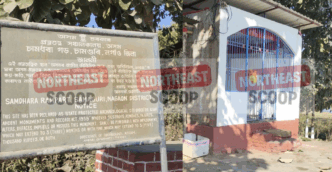
A large signboard installed by the Directorate of Archaeology, Assam, clearly states that the site is protected and that any destruction, alteration, or misuse is punishable with imprisonment or fine. The notice is displayed prominently in both Assamese and English at the fort site.
Despite this, permanent structures have reportedly come up right in front of the Archaeology Department’s signage within the last couple of months, raising serious concerns about enforcement and accountability.
“What is shocking is that the structure has come up in full public view, directly in front of a government signboard that declares the site protected. How can the government allow this?” Gogoi questioned.
The Directorate of Archaeology functions under Cabinet Minister Jogen Mohan, adding to the criticism that the violation has occurred under the watch of the very department meant to prevent such acts.
The High Court had set a six-month deadline in March 2025 for the government to complete the process of surveying, listing, and protecting heritage sites. Activists and historians now argue that instead of protection, visible violations are taking place on the ground.
“This is not about religion. This is about history, law, and respect for court orders,” Gogoi said, adding that the Ahom Sabha would continue to pursue legal and public action if the structure is not removed.