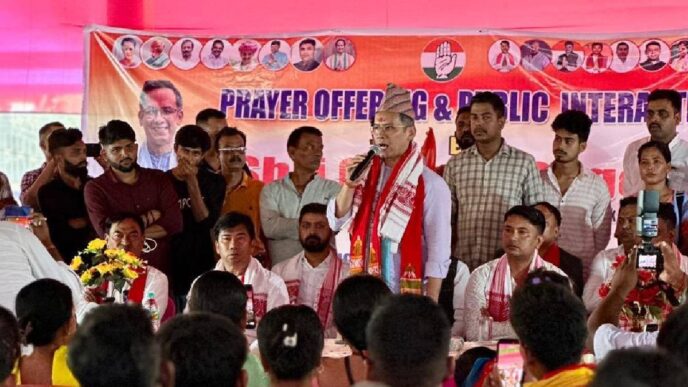




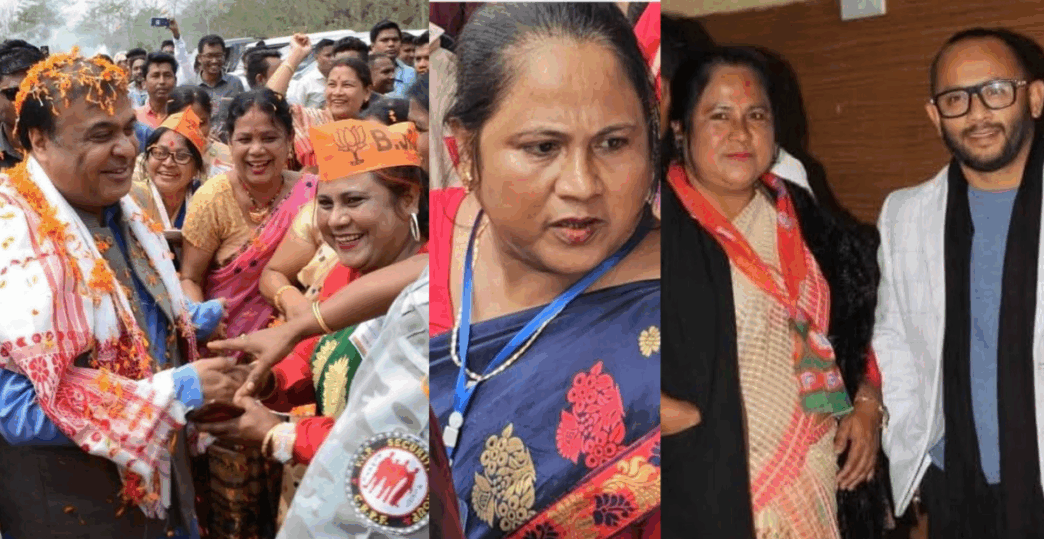
What began as a routine public meeting in Morigaon attended by Chief Minister Himanta Biswa Sarma has spiraled into a full-blown political debate across Assam. At the centre of the storm is a woman named Maina Begum, whose bold words have set off a chain reaction on social media and in political circles.
During the meeting, Maina Begum stood up and declared that the people “don’t need the Orunodoi scheme” the state’s flagship women-centric welfare programme and instead demanded “justice for Zubeen Garg.” Her spontaneous outburst in front of the Chief Minister instantly drew attention, resonating with many who continue to seek answers surrounding the singer’s death. But what followed was far beyond a citizen’s emotional plea it became a political flashpoint.
From public voice to political controversy
The controversy deepened when Assam Minister Pijush Hazarika took to social media, accusing Maina Begum of deliberately trying to disrupt the Chief Minister’s programme.
He claimed that her actions were “pre-planned” and orchestrated by the Opposition to create a scene. 
According to Hazarika, Maina Begum had contested against the BJP in the last Panchayat elections and therefore had clear political motives. He further pointed out that her husband is employed with the Assam Police, making her ineligible for Orunodoi benefits.
The Minister defended the government’s welfare policies including Orunodoi and Lakhpati Baideo asserting that these schemes have empowered lakhs of women across the state. He argued that people like Maina Begum may not understand the purpose and benefits of such programmes.
Hazarika also accused the Opposition of exploiting Zubeen Garg’s name for political gain, warning them not to “do politics in the name of an artist who belongs to all of Assam.” His post ended with a twist on one of Zubeen’s iconic lines — “Don’t do politics, friend.”
Congress fires back: “She’s a BJP worker”
Soon after, the narrative took another turn when Congress youth leader and NSUI National Secretary Mohsin Khan hit back on social media.
He dismissed the BJP’s claims, saying that “just because someone’s surname is Begum doesn’t make them Congress.”
Khan alleged that Maina Begum is, in fact, a booth-level BJP worker who attended the Morigaon event as part of a women’s group under the Lakhpati Baideo initiative — a programme promoted by the BJP government itself.
According to him, the BJP is now attempting to hide its internal embarrassment by projecting her as an Opposition plant. “If BJP supporters are calling their own member an Opposition agent, they should be ashamed,” Khan wrote.
Between politics and emotion
With both sides claiming contradictory versions, Maina Begum now finds herself in the eye of a political storm.
For the BJP, she’s a troublemaker sent by the Opposition. For the Congress, she’s a BJP worker silenced for speaking the truth. And for many citizens, she’s just a woman who dared to voice what many have been feeling — a demand for justice for Zubeen Garg.
On social media, opinions are split. Some argue that her statement was a simple expression of public emotion, not a political act. Others believe such disruptions at official programmes undermine democratic decorum.
Yet, one fact remains clear — Zubeen Garg’s name continues to hold a deep emotional chord in Assam. Whether invoked in grief or in protest, his legacy transcends party lines. But when politics begins to speak louder than the people, even a call for justice risks being drowned in noise.
The question that remains
Was Maina Begum’s outburst an act of political theatre — or the honest cry of a citizen tired of silence?
In Assam’s charged political atmosphere, even one woman’s words have proven powerful enough to unsettle the system.