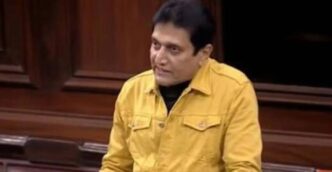




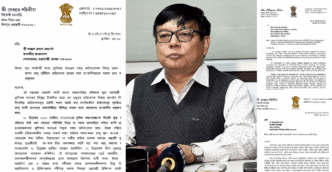
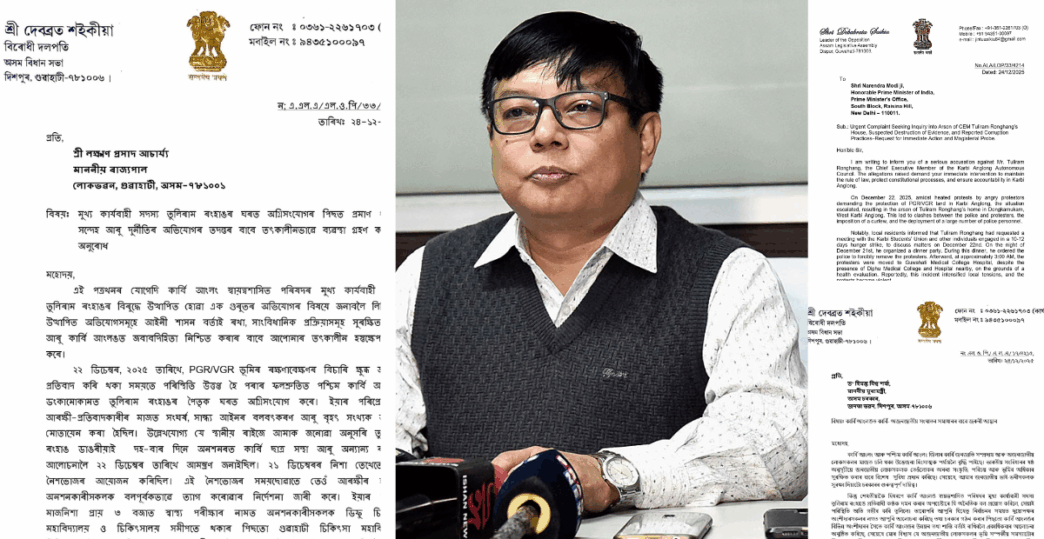
Assam Leader of Opposition Debabrata Saikia has written three separate letters to Prime Minister Narendra Modi, Assam Governor Gulab Chand Kataria, and Chief Minister Himanta Biswa Sarma regarding the recent violence and unrest in Karbi Anglong. In his letters, Saikia has expressed concern over the situation and has asked for urgent action, fair investigation, and long-term resolution of the tensions in the hill district.
The incident at the centre of the controversy took place on December 22, 2025. On that day, protests were being held in Karbi Anglong over demands related to protection of PGR and VGR land. The situation turned tense, and the home of Karbi Anglong Autonomous Council Chief Executive Member (CEM) Tuliram Ronghang at Dongkamukam was set on fire. Following this, clashes broke out, large security forces were deployed and curfew was imposed in parts of the district.
Saikia, in his letters, said that the matter became even more serious when the burnt house of the CEM was demolished almost immediately with a bulldozer. He said this action raised doubts about possible destruction of evidence. He pointed out that the structure should have been preserved for forensic and legal examination as it was part of a criminal investigation. He argued that demolishing the site before such examination may amount to destroying evidence under relevant provisions of law, and that this should be probed seriously. 
He also referred to local reports which claimed that the demolition took place without waiting for any judicial or administrative order. He wrote that this act could damage public trust in law-and-order systems and weaken the confidence of people in democratic institutions.
Saikia further highlighted that there have been allegations of corruption against CEM Tuliram Ronghang in the past. He said these allegations involved misuse of council funds, irregularities in land matters, and violations in project implementation. He wrote that because these allegations already exist, there is suspicion that evidence may have been hidden or destroyed during the demolition of the house. He demanded that the Lokayukta conduct an independent inquiry into these corruption charges in parallel with the criminal investigation.
In his letter to the Governor, Saikia focused on the legal and constitutional angle of the case. He said that the alleged bulldozing of the house before proper investigation violated due process. He urged the Governor to ensure that all actions taken in this case follow the rule of law. He also demanded sealing of the crime scene, recovery of remaining materials, and filing of cases against those responsible for allowing the demolition before completion of legal procedures.
At the same time, Saikia underlined the importance of the Sixth Schedule of the Constitution, which grants special protection to tribal communities in hill areas. He said the funds provided by the central government for such regions are meant for the welfare of tribal people, and any corruption involving these funds must be investigated firmly and transparently. He stated that constitutional protections must not be weakened under any circumstances.
In his letter to the Chief Minister, Saikia referred to the social tensions in Karbi Anglong. He said long-standing disputes between tribal and non-tribal populations over land and identity had contributed to the unrest. He wrote that many non-tribal families have been living in the area for decades and deserve a sensitive and lawful resolution. He said that while protecting tribal rights, the legitimate concerns of others also need to be addressed through dialogue and policy decisions rather than confrontation.
He urged the Chief Minister to call an all-party meeting involving council representatives, student organisations, community groups, and civil society, so that a peaceful, long-term solution can be worked out. He also called for immediate steps to restore normalcy, ensure safety of residents, and prevent further escalation of violence. He stressed that both tribal rights and constitutional protections must be upheld equally for all citizens.
Across all three letters, Saikia repeated several key demands. These include an urgent judicial or magisterial inquiry into the arson and demolition, sealing of the site for forensic work, suspension of the CEM pending inquiry, filing of cases against any officials who authorised bulldozer activity at the site, and an independent probe into corruption allegations by the Lokayukta. He said that only a transparent and lawful probe would restore public confidence in governance and justice.
Saikia also wrote that the developments in Karbi Anglong have the potential to disturb peace not only in the district but also in the wider region if not handled sensitively. He appealed for calm and urged the authorities to act in a manner that strengthens people’s faith in constitutional institutions rather than weakening it.