



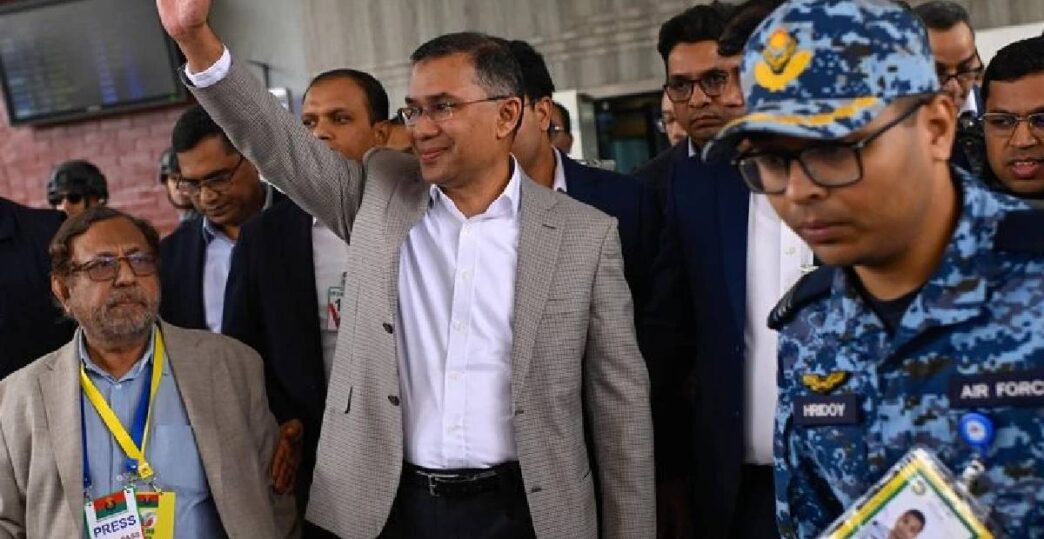
Tarique Rahman, the acting chief of the Bangladesh Nationalist Party (BNP) and son of former Prime Minister Khaleda Zia, has returned to Bangladesh after almost 17 years of self-imposed exile. His arrival in Dhaka is being seen as an important political moment for Bangladesh, which is heading towards a crucial national election in February. It is also being viewed closely in India, as the political direction of Bangladesh has significant regional impact.
Rahman, who had been living in London since 2008, landed in Dhaka along with his wife Dr Zubaida Rahman and their daughter, barrister Zaima. Soon after arriving, he posted that he had returned “after 6,314 days,”.
His party workers gave him a grand welcome. Lakhs of BNP supporters gathered in Dhaka, many travelling by special trains and buses arranged for the event. A long roadshow was held from the airport to his residence, with party flags, slogans and celebrations. Senior BNP leader Ruhul Kabir Rizvi said the moment was “politically defining” for the country. 
Bangladesh is currently going through a tense and uncertain phase. Former Prime Minister Sheikh Hasina, who had ruled the country for several years and maintained close ties with India, is no longer in power. An interim government led by Nobel laureate Muhammad Yunus is now running the country.
During the past year, the political environment has changed sharply. Radical organisations, including the Jamaat-e-Islami, have gained ground again after being sidelined earlier. Their student wing even won elections at Dhaka University, which has worried many observers in India. New Delhi views Jamaat-e-Islami as being close to Pakistan’s intelligence agency, the ISI.
In this backdrop, the BNP is being seen as a comparatively moderate and democratic force, despite its earlier uneasy relations with India. Political analysts believe New Delhi may now prefer a BNP-led government rather than one influenced by hardline Islamist groups.
India has always considered political stability in Bangladesh as essential for regional peace and security. Under Sheikh Hasina, India and Bangladesh worked closely on security, trade, and connectivity. She also maintained distance from Pakistan and tried to balance relations with China.
However, the interim government under Muhammad Yunus has taken a different approach. There have been reports of closer interactions with Pakistan, and ties with India have cooled to some extent. This has increased New Delhi’s concerns.
Recently, there have been signs that India and the BNP are attempting to improve ties. On December 1, Prime Minister Narendra Modi expressed concern about Khaleda Zia’s health and offered support. The BNP publicly thanked him, which was seen as a rare friendly exchange between the two sides.
Rahman has also criticised the interim government and questioned its authority to make long-term policy decisions. He has refused to form an alliance with Jamaat-e-Islami and has positioned himself as a supporter of democracy and national interest. At one point, he even said that Bangladesh would not blindly follow either Delhi or Islamabad, stressing that the country must think of itself first.
Reports suggest that Rahman may contest from the Bogura-6 constituency, while his mother Khaleda Zia could again stand from her traditional seat in Bogura-7. The elections are expected to be competitive and heated, especially with Jamaat-e-Islami trying to regain political relevance.
Security agencies in Bangladesh have already warned of possible clashes between rival groups during the campaign period. Several lakh BNP supporters entering Dhaka for Rahman’s roadshow has also made authorities cautious. Strict security arrangements were put in place for his arrival.
Tarique Rahman’s political journey has been controversial. He is the son of former President Ziaur Rahman and Khaleda Zia, both of whom led Bangladesh at different times. During the BNP government between 2001 and 2006, Rahman was accused of corruption and misuse of power. He was arrested in 2007 and later received court permission to travel to London for medical treatment.
He was also convicted in absentia in the 2004 grenade attack on an Awami League rally, in which 24 people died. Sheikh Hasina narrowly escaped that attack. The Dhaka Tribune newspaper later referred to Rahman as the “dark prince” due to the allegations surrounding him.