



A young Kuki-Zo woman, who survived abduction and brutal sexual violence during the early days of the Manipur conflict in May 2023, has died after nearly three years of suffering—without seeing justice delivered in her case.
The woman, identified as Lhingnu Haokip (name changed), passed away on January 10, 2026, at Apollo Hospital, where she had been undergoing long-term treatment for severe injuries caused by the violence. She was around 20 years old at the time of her death.
Lhingnu was just 18 when the incident took place. A resident of New Checkon Colony in Imphal, a mixed-ethnic area that became one of the early flashpoints of violence, her life changed forever within days of the conflict breaking out on May 3, 2023. 
According to survivor accounts and records compiled by community groups, the incident occurred on May 15, 2023. Lhingnu had stepped out to an ATM in New Checkon to withdraw money when she was allegedly stopped by members of the Meira Paibis, a Meitei women’s group. She was reportedly assaulted and questioned about her identity before being handed over to armed men allegedly linked to the Meitei militia group Arambai Tenggol.
The assailants, reportedly dressed in black and carrying firearms, allegedly blindfolded her, tied her hands, and took her across several locations in Imphal, including Wangkhei Ayangpali and Langol. During this time, she was subjected to repeated gang rape and severe physical assault.
Left in a critical condition and believed to be dead, Lhingnu managed to escape. She was later rescued by an autorickshaw driver from the Muslim community, who took her to safety and helped her receive medical care.
She was first treated in Manipur but was later referred to Guwahati, as local hospitals were not equipped to handle the extent of her injuries. Doctors said she suffered serious internal damage, including severe uterine injuries, along with recurring infections and trauma-related complications.
For nearly three years, Lhingnu moved between hospital wards and legal processes, living in constant pain. Medical sources said her condition gradually worsened, eventually leading to her death due to complications arising from the injuries she sustained during the assault.
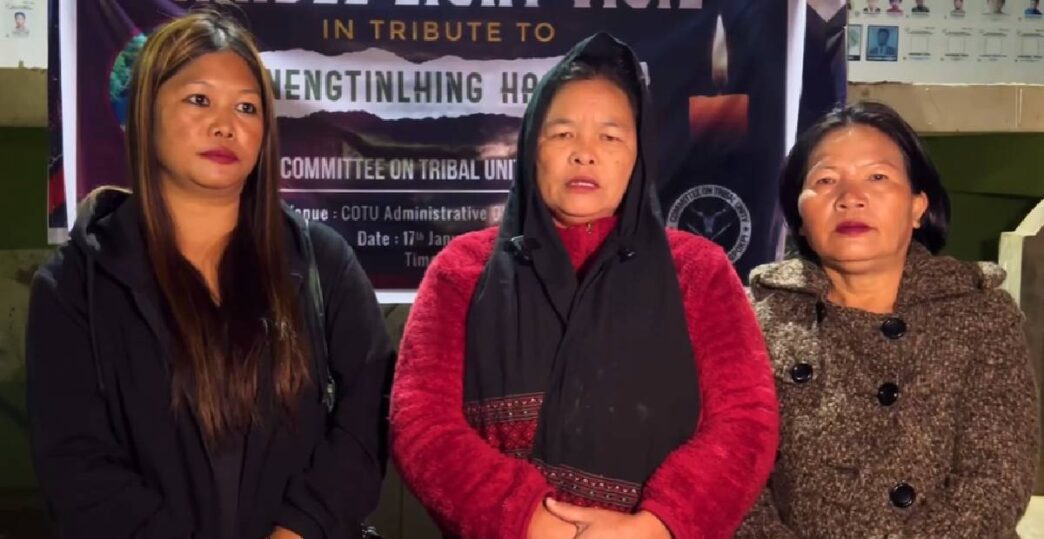
Following her death, the Committee on Tribal Unity (CoTU) expressed deep sorrow and anger. Candlelight vigils were held at Brigadier M. Thomas Ground in Kangpokpi and at the Wall of Remembrance in Churachandpur under the banner of the Indigenous Tribal Leaders’ Forum (ITLF).
CoTU spokesperson Ng. Lun Kipgen said Lhingnu survived the violence but not the silence that followed. He said her death reflects a complete failure of the system to protect victims and punish perpetrators.
“She fought to live for nearly three years, but justice never came,” Kipgen said. “While she struggled with pain and trauma, the case remained stuck in delay.”
An FIR was registered under Sections 354, 307, 364, 376, and 506 of the Indian Penal Code, along with provisions of the Scheduled Castes and Scheduled Tribes (Prevention of Atrocities) Act. However, nearly three years later, no arrests have been made, and no accused has been punished.
Kipgen said Lhingnu’s story now represents many unheard victims of the Manipur conflict. “She survived abduction and sexual violence, but she could not survive a system that failed her at every step,” he said.
Strongly condemning the inaction of authorities, Kuki Women’s Union (KWU), Sadar Hills President Nengboi Hmar said the most painful truth is that the survivor died waiting for justice.
“She carried her suffering to the grave,” Hmar said emotionally. “Justice delayed is not just justice denied. It is humanity denied.”
Questioning the response of both the Central and State governments, Hmar asked whether such cases are being allowed to fade into silence. She said the continued delay shows a deep failure of governance and disregard for the dignity of victims.
Raising concerns over the safety of her community, Hmar said such incidents explain why coexistence has become impossible. She reiterated the demand for a separate administration in the form of a Union Territory with Legislature, stating it is the only way to ensure safety, dignity, and justice for the people.