



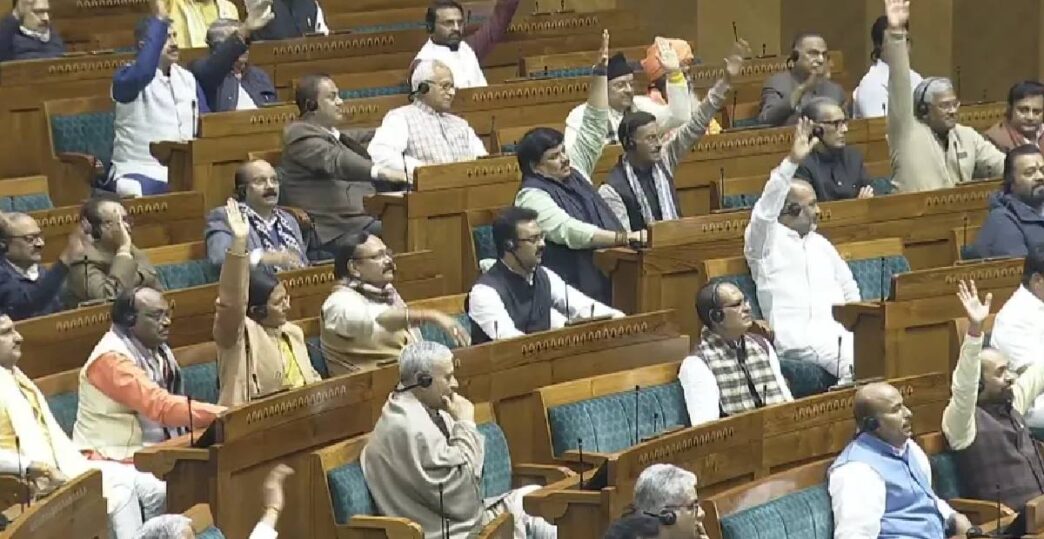
The Lok Sabha on Thursday passed the Viksit Bharat Guarantee for Rozgar and Ajeevika Mission (Gramin) Bill, 2025. The Bill seeks to replace the Mahatma Gandhi National Rural Employment Guarantee Act, commonly known as MGNREGA. The passage of the new Bill led to strong protests from opposition members. Many MPs said that the government was insulting Mahatma Gandhi and weakening the rural job guarantee law.
The Union Rural Development Minister, Shivraj Singh Chouhan, defended the Bill in the House. During his reply to the discussion, he said that the original law did not contain the name of Mahatma Gandhi. He said that Gandhi’s name was added later with an eye on the 2009 general elections. Chouhan claimed that the Congress included the name for electoral gains. He said that the Modi government had implemented the job guarantee scheme in a stronger and more effective way.
The minister also said that the present government was promoting the values of Gandhi through various welfare schemes. He named housing schemes, LPG distribution, sanitation drives and health insurance as examples where, according to him, the ideals of Gandhi were reflected. He also rejected the accusation of renaming schemes and pointed out that many programmes carried the names of leaders like Jawaharlal Nehru and Mahatma Gandhi. 
As Chouhan finished his address, the opposition members moved to the well of the House shouting slogans against the government. They opposed the removal of Gandhi’s name from the job scheme. Some MPs tore copies of the Bill and threw them towards the Speaker’s chair. Earlier in the day, the opposition had held a protest march in the Parliament complex demanding that the government withdraw the Bill. Congress president Mallikarjun Kharge said the legislation was an insult to Gandhi and a blow to the right to work, which had supported poor rural families for nearly two decades. Sonia Gandhi and several other MPs joined the protest at Makar Dwar.
The Viksit Bharat Guarantee for Rozgar and Ajeevika Mission (Gramin) Bill provides a statutory guarantee of 125 days of wage employment in a year for every rural household whose adult members are willing to do unskilled manual work. The Bill also directs states to bring their existing schemes in line with the new law within six months of the Act coming into force.