




The Gauhati High Court’s recent direction to the Assam government to survey and protect Ahom Dynasty historical monuments has once again brought focus to the fragile state of Assam’s rich heritage. While the court has given a clear six-month deadline and ordered continuous monitoring to stop illegal coal mining in historically sensitive areas like Tipam Hills, questions remain on how much of this order will translate into real action on the ground.
Speaking exclusively to Northeast Scoop, Ahom Sabha State General Secretary Tapan Kumar Gogoi shared his views on the court’s direction, the damage already caused by years of illegal mining, and the need for a long-term protection system involving local communities.
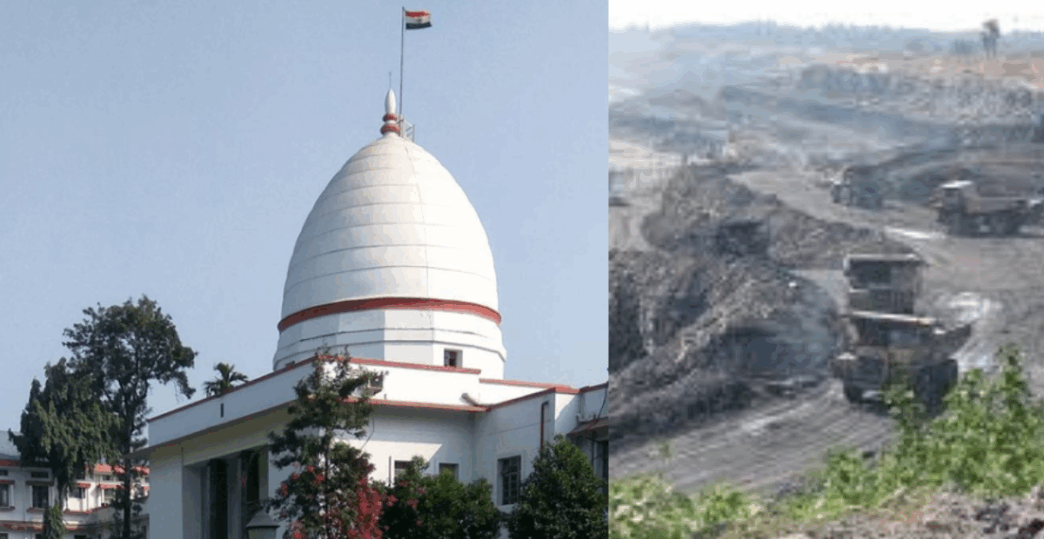
The Gauhati High Court, while disposing of a suo motu public interest litigation on February 12, 2025, directed the Assam government to complete an archaeological survey and take steps to protect Ahom Dynasty monuments within six months. The court also ordered regular monitoring of Tipam Hills in Digboi to prevent illegal coal mining by smugglers. 
Asked whether the government appears serious about implementing the order, Gogoi gave a cautious and realistic response.
“Some work has been done by the government for protection, whatever is in our knowledge and whatever we can see,” he said. “But whatever is not in our knowledge, for those places the government has not done much. That is why we approached the High Court.”
According to Gogoi, the court intervention became necessary because protection efforts were uneven and limited to a few known sites. Many Ahom-era structures and locations, especially in remote areas, remain unprotected and undocumented.
He pointed out that proper protection of these monuments is not only about preserving history, but also about opening up long-term benefits for the state.
“If the government has the intention, then this will help the tourism department also,” he said. “In every district, the historical sites should be identified and protected so that our history remains history and is preserved.”
However, Gogoi warned that good intentions alone are not enough.
“If the government really has the intention that tourism will develop through this, then the government will come forward and do the work,” he said. “Otherwise, it will remain only on paper.”
He also noted that Assam’s tourism sector has not received enough focused investment over the years, especially when it comes to heritage-based tourism.
“The government has not invested much in the tourism sector earlier,” he said. “But if now the government has the intention, they can do it. They cannot do everything at one time, but step by step it is possible.”
One of the most serious concerns raised in the PIL was the long-running illegal coal mining in Tipam Hills, an area with deep historical links to the Ahom dynasty. Though the court was informed that illegal mining activities had been stopped for the past two years, the damage caused over decades remains a major worry.
Asked how much irreversible damage has already been done to Ahom heritage sites in Tipam Hills, Gogoi did not mince words.
“Definitely, illegal coal mining has damaged everything,” he said. “The place has history, and that history has been damaged.”
According to the Ahom Sabha’s assessment, a large portion of Tipam Hills has already suffered extensive harm.
“As per our assessment, in Tipam Hills maximum areas have been damaged,” Gogoi said.
He added that while some of the damage may be permanent, all hope is not lost.
“For restoration, more economic support is required,” he explained. “If the government has the intention, then restoration is possible to some extent. Restoration is the need of the hour.”
Gogoi stressed that restoration does not mean recreating history artificially, but stabilising and preserving whatever remains, documenting sites properly, and preventing further destruction.
The High Court has directed continuous monitoring of Tipam Hills to prevent illegal coal mining in the future. But Gogoi believes monitoring cannot be effective unless there is a permanent and inclusive system in place.
“Definitely, local communities and organisations should be involved in monitoring,” he said.
He welcomed the idea of government policies aimed at heritage protection but emphasised that policies alone are not enough.
“Government making policy is good,” he said. “But after starting the work, continuation is very important.”
According to Gogoi, there must be a system where responsibility does not end once a project is announced or a survey is completed.
“Someone must be engaged and involved, like Ahom organisations or local communities,” he said. “It is important to continue the legacy and maintain the history.”
He also highlighted the role of people beyond government action.
“It should not happen that only if the government does something, then things will move,” Gogoi said. “Even if the government has done something, people should come forward and do something on their own.”
The Gauhati High Court took suo motu cognisance of a newspaper report on illegal coal mining in Tipam Hills that was destroying historically important Ahom sites. The case was heard by a Division Bench of Chief Justice Vijay Bishnoi and Justice Suman Shyam.
During the proceedings, the court was informed that illegal mining had been stopped for the past two years and that regular monitoring was being carried out. However, when it came to the protection of Ahom Dynasty monuments, the court sought clarity on what concrete steps had been taken.
The Directorate of Archaeology informed the court that a survey was being conducted to identify historical monuments, verify their authenticity and integrity, and study archaeological findings. Based on this, the court directed the state to complete the exercise within six months and take necessary protective measures. The court also ordered continued supervision of Tipam Hills to prevent illegal mining.
The PIL was then disposed of, with the court making it clear that the responsibility now lies with the state to act within the given timeframe.
For Ahom Sabha, the court order is an important opportunity, but also a test of intent.
“This is a chance for the government to show seriousness,” Gogoi said. “If done properly, it will help history, culture, and tourism.”
He believes that a district-wise approach, proper documentation, community involvement, and steady funding can make a real difference over time.
“Everything cannot be done together,” he said. “But if the work is done step by step, it is possible.”