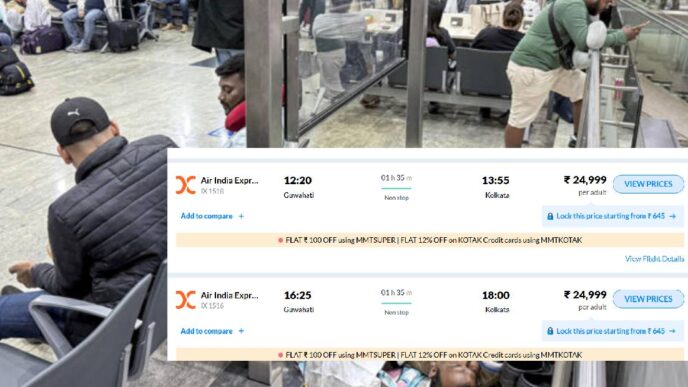





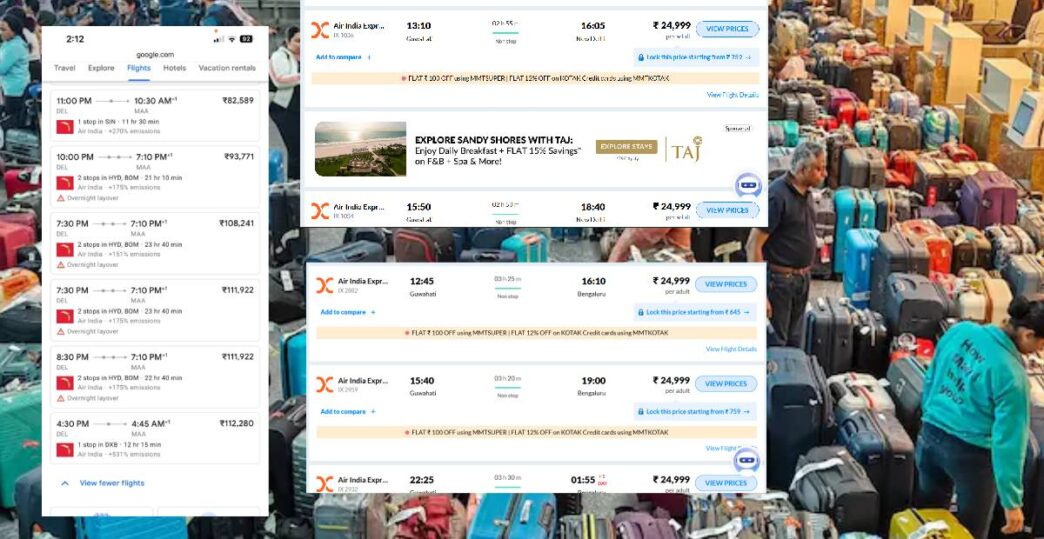
The nationwide cancellation of IndiGo flights over the past few days has created a sudden spike in airfares, with passengers from Guwahati facing some of the steepest prices in recent months. Several travellers reported that flights from Guwahati to Delhi, Mumbai and Bengaluru were showing fares ranging from Rs 80,000 to well over Rs 1 lakh, especially on multi-stop routes. Screenshots shared by passengers displayed fares such as Rs 82,000, Rs 93,000, Rs 1,08,000, Rs 1,11,000 and even Rs 1,12,000, highlighting the sharp rise in ticket prices across major routes as alternative options quickly filled up after the cancellations.
At Lokpriya Gopinath Bordoloi International Airport in Guwahati, many passengers reported last-minute alerts informing them that their IndiGo flights had been cancelled or delayed indefinitely. Several travellers said they had reached the airport early in the morning, only to be told that they would have to either accept a refund or book new tickets at much higher prices. With IndiGo operating a significant number of flights connecting Guwahati to the rest of India, the disruptions have had a direct impact on passengers flying to neighbouring states and major metro cities.
The cancellations have also pushed airfares upward on other airlines, as the sudden demand for seats has outpaced supply. Travellers checking tickets from Guwahati to destinations such as Aizawl, Agartala, Delhi and Mumbai reported that many flights were showing limited availability, while some were priced far above their usual range. Although exact fare data varies by time and date, passengers widely complained that the cost of emergency travel had become unaffordable for many families, students and medical travellers. 
For routes within the Northeast, especially Guwahati to Aizawl and Guwahati to Agartala, the shortage of seats became apparent soon after the cancellations began. These short-distance flights usually serve as essential links for work, health and education-related travel. With IndiGo flights grounded, remaining services on other airlines filled up quickly, leaving some passengers with no option except to postpone or cancel their plans altogether.
The situation was no better for long-distance routes to major cities such as Delhi and Mumbai. As the cancellations rippled across the country, airfares on these trunk routes saw steep jumps. Many travellers trying to return to work or attend important appointments said they were forced to book connecting flights at much higher rates. Several passengers at Guwahati airport described the experience as “chaotic” and “stressful,” adding that even after paying high prices, seat confirmation was not guaranteed.
Travel agencies in Guwahati also reported an unusually high number of queries from stranded passengers. Some agencies said that fares on sectors normally considered affordable had suddenly surged, leaving customers unsure of whether to wait or book immediately. Others pointed out that the lack of clear communication from airlines added to the confusion, as passengers struggled to understand whether more cancellations would follow.
The broader impact of IndiGo’s disruptions was felt across the country, but for the Northeast—where air connectivity is already limited—the problem became more serious. With fewer flights operating and demand remaining high, the price rise was almost immediate. Several passengers said they were exploring alternatives such as overnight buses or trains, though these were not viable options for long-distance or urgent travel.o’s full operational restoration, travellers were advised to check schedules frequently and keep backup plans ready.