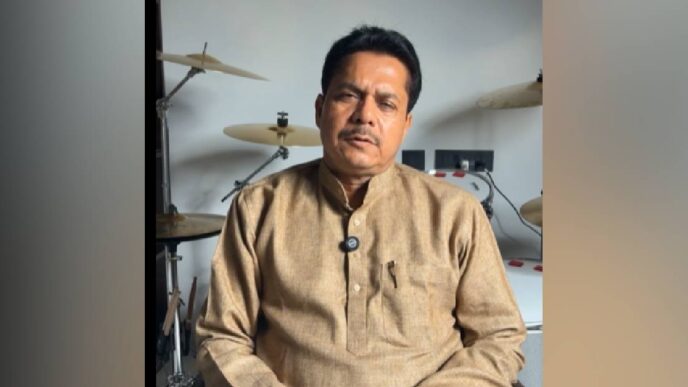




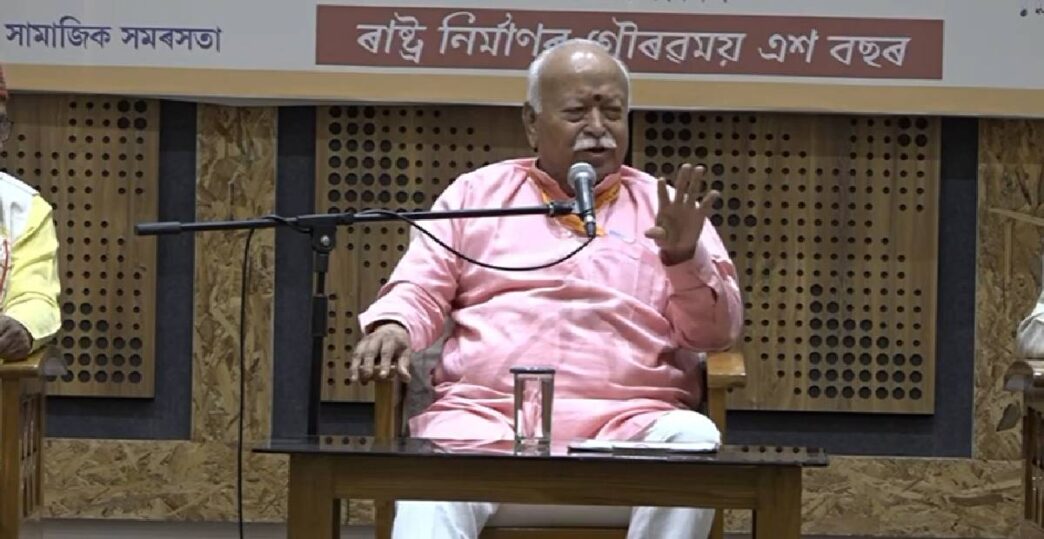
RSS Sarsanghchalak Dr Mohan Bhagwat on Wednesday addressed a Youth Leadership Conclave in Guwahati, where he urged young people of Assam and the Northeast to understand the RSS through direct observation rather than opinions shaped by preconceived notions or misinformation. The event, held at Sudarshanalaya in Barbari, brought together over a hundred young representatives from different sectors.
Dr Bhagwat, who is on a two-day visit to Assam, began his speech by saying that the RSS has become a frequent subject of public debate. He said such discussions should be based on facts and not on hearsay or motivated propaganda. He also pointed out that on some international and digital platforms, nearly half of the information about the RSS is incorrect or incomplete. According to him, there is also a deliberate attempt in certain media outlets to spread misinformation about the organisation.
The programme opened with a patriotic song performed by vocalist Sharat Raag. Organisers described the conclave as an important opportunity for young people in the region to learn more about the Sangh and its activities. While recalling the vision of RSS founder Dr Keshav Baliram Hedgewar, Dr Bhagwat said that the organisation aims to help build a society that can guide the nation towards becoming a “Vishwaguru,” or a teacher to the world. 
He said that a nation rises only when its society rises, and that unity and quality within society are essential for progress. Referring to the growth of developed nations, he noted that their first century of advancement was focused on building a strong and united social foundation. He added that India must follow a similar path, and that this is reflected in the RSS’s five principles of social transformation, adopted during its centenary year.
Dr Bhagwat stressed that India’s true strength lies in its long tradition of respecting diversity—whether linguistic, regional or related to beliefs. He said such a mindset is not found in many other countries, and that India has always held the view that one’s own path may be right, but another person’s path can also be right in their own place. He pointed to the example of neighbouring regions that broke away from India and later lost their own linguistic and cultural diversity.
He said that respecting diversity is central to Hindu civilisation, and that building a society that holds this value is the core aim of the RSS. He said that unless Indian society becomes organised and virtuous, the nation’s future will not improve. He also recalled the teachings of Guru Nanak and Srimanta Sankardeva, saying that they respected the country’s diversity and spread messages of harmony. According to him, diversity should be seen as a celebration of unity.
Dr Bhagwat described the RSS as a “man-making methodology” whose main goal is to develop individuals who contribute positively to society. He said that creating strong individuals leads to a strong society, which then leads to stronger systems and institutions. He encouraged the youth to take part in RSS shakhas to see how the organisation works to build character and discipline.
During an interactive session, he said that corruption can only be removed through character-building and not just through legal measures. He also spoke about the need for scientific knowledge on cow protection at the societal level, in addition to existing legal provisions.
Reiterating the organisation’s commitment to building a stronger India, Dr Bhagwat said that many concerns between the Northeast and the rest of the country will naturally fade as Bharat becomes stronger. He said India must follow a foreign policy that is guided solely by national interest, and should not become pro or anti any other nation, including the USA or China. He said both those countries act based on their own interests, and India must also adopt a clear “Bharat First” approach. A strong and self-reliant India, he added, can help safeguard its own interests and also contribute to global peace.
Dr Bhagwat called upon youth to associate with the activities of the RSS according to their ability, time and interest. He said the organisation is a natural part of society and that its presence in the northeastern region continues to grow steadily.