



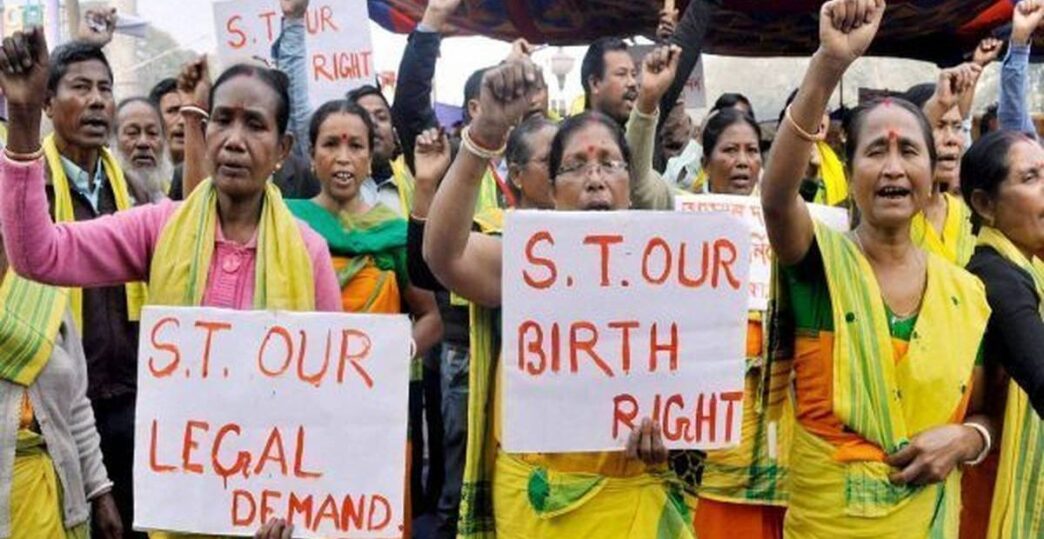
The Coordination Committee of the Tribal Organisations of Assam (CCTOA) has announced a large public rally to be held on November 10, 2025, at the Mini Stadium in Sonapur, Kamrup (Metropolitan). The rally, scheduled to begin at 11:00 a.m., aims to protest the government’s decision to grant Scheduled Tribe (ST) status to six communities of Assam: Koch Rajbongshi, Tai-Ahom, Chutia, Moran, Motok and Adivasi (Tea Tribes).
According to the CCTOA, the move by the Government of Assam and the Government of India to include these six communities in the ST list poses a serious threat to the rights and representation of the existing tribal communities of the state.
In a statement issued from the CCTOA office at the Tribal Rest House in Paltan Bazar, Guwahati, Secretary General Aditya Khakhlari said the decision was “a conspiracy to destroy and eliminate the genuine Scheduled Tribes of Assam.” He added that if these six large and advanced communities are granted ST status, it would “wipe out the political and social existence of the original tribal groups.” 
The CCTOA argued that granting ST status to these six populous and economically stronger groups would severely affect the political representation of existing tribes—from the Gram Sabha to the Lok Sabha. The organisation fears that reserved seats meant for Scheduled Tribes could then be contested by members of these newly included groups, leaving smaller and marginalized tribes without representation.
The statement further noted that such a move could also impact the Autonomous Councils under the Sixth Schedule, including the Bodoland Territorial Council (BTC), Karbi Anglong Autonomous Council (KAAC), and Dima Hasao Autonomous Council, as well as other state-created councils such as those for the Tiwa, Mising, Rabha Hasong, Deori, Thengal Kachari, and Sonowal Kachari communities. The CCTOA warned that allowing members of the six communities to contest in these reserved seats would “defeat the very purpose” of these councils, which were formed to protect the rights of indigenous tribes.
The committee also raised concerns about the impact on education and employment opportunities. It cited examples from other states, noting that in Rajasthan, the Meena community, which forms only 1.6 percent of India’s ST population, had secured over 35 percent of ST-reserved seats in the UPSC Civil Services Examination in 2013–2014. The CCTOA said a similar situation could occur in Assam, where smaller tribes would find it impossible to compete with these larger, well-established groups.
“The inclusion of these six advanced and populous communities will destroy the chances of our students and youth to access higher education and government jobs under ST reservation,” the statement read. The organisation also expressed that such a step would threaten the language, culture, and identity of existing tribal groups, who have long struggled for recognition and development.
The CCTOA alleged that the move is politically motivated, aimed at gaining electoral advantage rather than ensuring genuine tribal development. It said that for decades, promises for tribal welfare have existed only on paper, and the government has failed to deliver on its commitments.
In its appeal, the committee has called upon all tribal groups across Assam and India to unite and oppose what it termed as an “unjust and dangerous” decision. It urged them to participate in the Mass Rally at Sonapur and to take both legal and political measures to resist the proposed inclusion of the six communities in the ST list.