



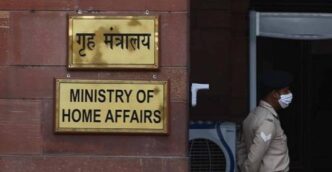
The Ministry of Home Affairs (MHA) has held an important two-day round of talks with representatives of Kuki-Zo armed groups in New Delhi on November 6 and 7. The meetings were part of the ongoing peace process under the Suspension of Operation (SoO) agreement and were mainly focused on the community’s long-pending demand for a separate Union Territory with a Legislative Assembly.
The discussions took place between senior officials from the MHA, led by A.K. Mishra, Advisor (North East), and leaders of the Kuki National Organisation (KNO) and the United People’s Front (UPF), the two umbrella groups representing the political and armed wings of the Kuki-Zo people.
According to sources, the first day of the talks centred around reviewing the implementation of the tripartite agreement signed on September 4 between the MHA, the Government of Manipur, and the SoO groups. The Kuki-Zo representatives pointed out that law and order in their areas have deteriorated badly since the ethnic violence erupted in May 2023. They said normal governance had broken down in the Kuki-Zo inhabited hill districts, and therefore, there was an urgent need for an alternative administrative arrangement to ensure peace and development. 
On the second day, discussions focused mainly on the Kuki-Zo community’s political demand for a Union Territory with its own legislature. The delegation of KNO and UPF made it clear that coexistence with the present state government of Manipur is no longer possible after what they described as “ethnic cleansing” that began in Imphal on May 3, 2023.
The leaders argued that their demand is based on both historical facts and constitutional provisions. They pointed out that before India’s Independence, the Kuki-Zo Hills were never under the control of the Manipur State Durbar and were marked as an “Excluded Area” under the Government of India Act, 1935. This area, they said, was directly administered by the British Political Agent and not by the Meitei king.
They further explained that the Kuki-Zo society follows a chieftainship system of land ownership, which is very different from the valley’s system of state-controlled land. Because of these historic differences, they said, the present administrative structure of Manipur does not suit the traditional and social setup of the Kuki-Zo people.
Describing their demand as a “restoration of pre-Independence autonomy,” the representatives told the Centre that they were not seeking division or separation from India. Instead, they said their demand is aimed at achieving equal governance, better security, and balanced development under the Indian Constitution. They also recalled that when Manipur merged with India in 1949, the Meitei ruler received compensation, but tribal chiefs did not—leaving their traditional rights unrecognized to this day.
Responding to their statements, A.K. Mishra assured the Kuki-Zo delegations that the Government of India understands their concerns. However, he also made it clear that the current policy of the Centre does not support the creation of new Union Territories. He underlined the importance of consulting all communities of Manipur before making any administrative changes.
Even so, the KNO and UPF urged the Central Government to review its policy stance, saying that constitutional provisions should take precedence over policy restrictions. They appealed to the MHA to invoke constitutional measures that can protect the rights, lands, and security of the Kuki-Zo people.
Apart from the main political demand, the discussions also covered important issues related to land and forest ownership, recognition of traditional chieftainship, and the pace of tribal development projects. The leaders from the SoO groups requested that the MHA take direct steps to protect tribal ownership of land and make administrative procedures simpler. They said the requirement of visiting Imphal for land registration and related work had become unsafe and impractical since the start of the violence.
The groups also raised the issue of Internally Displaced Persons (IDPs). They urged the government to speed up the rehabilitation process and ensure proper housing, security, and basic amenities for displaced Kuki-Zo families who are currently living in relief camps in different areas.