



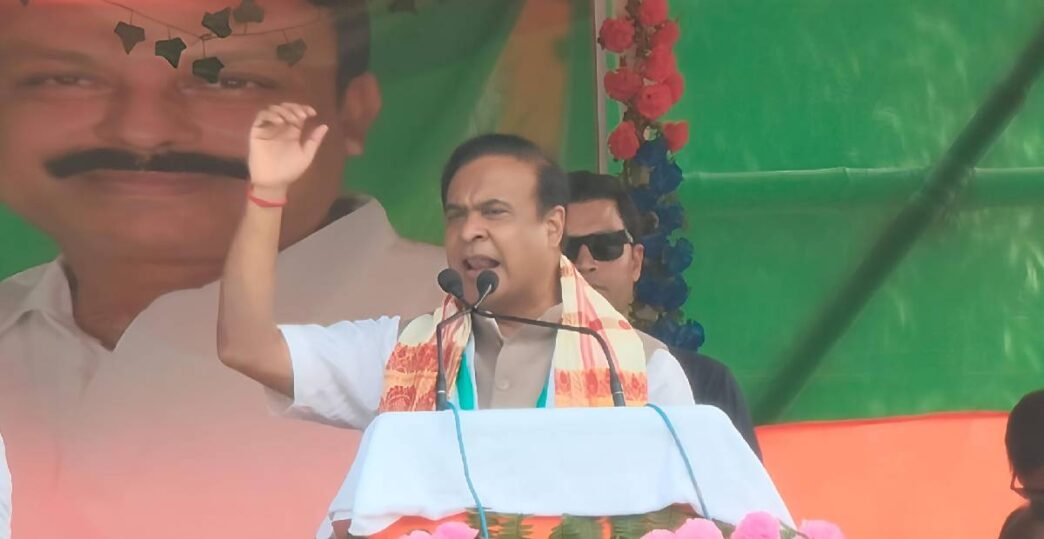
At a packed election rally in Bihar’s Raghunath Pur on Tuesday, Assam Chief Minister Himanta Biswa Sarma made sharp remarks touching on religion, land, and identity, claiming that a huge parcel of land in Assam was occupied by “people who came from Bangladesh” during earlier Congress governments. Sarma linked this issue to a larger narrative of protecting Hindu rights and stopping what he described as illegal encroachment and cultural threat.
Sarma told the crowd that when he became Chief Minister, senior officers informed him that nearly one lakh acres of government land in Assam had been taken over. He alleged that these encroachers were “Bangladesh-origin people” and said the land occupation was allowed because of the Congress period, where, according to him, the administration “looked the other way.” He said that after taking charge, he felt morally duty-bound to act and reclaim the land.
According to Sarma, reclaiming the land was not easy. He said some people lost their lives, some were arrested, and there were tense moments on the ground, but the state pushed ahead with the eviction drives. “If a Ram temple can be built after many years, then we can also reclaim the land that belongs to us,” he told the crowd, drawing loud applause. He described the eviction drives as a matter of “identity and self-respect,” and insisted that the state government had successfully taken back thousands of acres. 
Throughout his speech, Sarma repeatedly framed the conflict as part of a larger Hindu-Muslim divide, calling it a reality in Assam. He said Assam has around 70% Hindus and 30% Muslims, and claimed that certain groups within the Muslim community controlled land, took government benefits, and tried to influence the social structure. He used this reasoning to defend his government’s actions against encroachment and illegal occupation.
Sarma also spoke in detail about madrasas in Assam. He said that when he became Chief Minister, he asked officials what role madrasas played. According to him, the state’s job is to build doctors and engineers, not only religious scholars. He claimed that madrasas, especially those running since pre-independence days, were producing clerics in a way that could “increase arrogance.” He said some madrasas had been shut down under his government to push for modern education and curb what he called internal threats to the state. “No one had the courage earlier,” he said, adding that this was part of a larger plan to “protect Assam’s social fabric.”
The Chief Minister then shifted to voter lists, saying that land grabbers should not have voting rights. He praised the Bihar government and Prime Minister Narendra Modi, claiming that voter rolls in Bihar had been revised and names of encroachers were removed. He said similar action was being taken in Assam, Bengal, and Jharkhand. “Those who grab land have no right to vote in this country,” he stated, arguing that voter rolls must reflect only lawful residents.
Sarma portrayed his government’s approach as firm, saying illegal behaviour will not be tolerated. He cited a new policy under which repeat offenders cheating people in markets will face closure of their shops or even jail. He argued this was necessary for law and order and to build a disciplined society.
The Chief Minister struck a strong nationalist note, saying India has changed under Modi’s leadership. He claimed that in earlier times, Pakistan sent terrorists and India did not respond strongly, but now the country answers forcefully. He said Hindus were once humiliated, but now “Hindus have woken up,” and the nation would not allow suppression again. He said this election was about dignity and identity, telling the crowd that they must stand firm and vote for development and protection of culture.
Sarma also criticised Congress and other Opposition leaders, saying that during their rule people like “Saahabuddin and Usama” held influence. He claimed those times are gone and development is now the priority. He accused Opposition leaders of doing “communally-driven appeasement politics” and said voters should remain alert and reject such politics.
Sarma spoke to the theme of unity and Hindu pride. He reminded the audience of the fight for “self-respect” and said Hindus will not accept defeat. He compared today’s political climate to a “new era” where the country is assertive and traditional values are strong. He also invoked religious imagery, saying Lord Krishna returns in different forms whenever dharma needs protection.
Sarma said that growth and modernisation are the answers to extremism and conflict. He urged voters to choose leaders who build roads, electricity and industries not leaders who, in his words, “take money and buy votes.”